



Selecting the appropriate operating system (OS) for your VPS will impact the server’s speed, security, scalability, and management. Though CPU, memory, and storage space matter, the operating system is what makes use of these resources most effectively.
From serving web pages to executing applications and databases and setting up a development environment, the proper VPS OS selection can be useful in improving efficiency.
How does the Operating System Influence VPS Performance and management?
A VPS provides dedicated resources within a virtualized environment, giving users greater control than shared hosting plans. The operating system acts as the layer that manages those resources and provides the environment in which applications run.
It affects several critical aspects of server administration, including:
- Software compatibility
- Resource allocation
- Security patch management
- Application deployment processes
- Infrastructure scalability
Choosing an operating system that aligns with your technical and business requirements helps create a more stable and manageable hosting environment
Define Your Hosting Requirements Before Selecting an OS
Prior to selecting between operating systems, determine which applications and services will be installed on the VPS.
Different application loads have different needs:
- WordPress sites generally function very well on Linux-based server installations.
- PHP and MySQL are frequently hosted within Linux environments.
- Development machines can also utilize Linux distributions due to their flexibility and availability of many package repositories.
Once we understand the software stack to be used, we can exclude the unnecessary OS from the choice.
Linux vs Windows VPS: Understand the Differences
Deployment of most VPS services usually involves using either Linux or Windows. The decision as to which would be suitable in one’s case depends entirely on the technologies used by a firm, as well as their capability to manage the server.
Linux VPS Operating Systems: Linux is the best option for several websites and web applications due to its stability, versatility, and effective use of resources.
Advantages:
- No licensing costs
- Highly secure
- Effective use of resources
- Open-source support
Some of the commonly used Linux distributions are Ubuntu Server, Debian, AlmaLinux, and CentOS Stream.
Linux is highly utilized for CMS platforms, eCommerce websites, cloud-based apps, and application development.
Windows VPS Operating Systems: Windows Server is often preferred by organizations that make use of Microsoft software products.
Advantages:
- Microsoft SQL Server compatible
- Supports Active Directory
- User-friendly graphical interface
However, the use of Windows Server requires additional licensing costs and consumes more server resources compared to Linux.
Compare Popular VPS Operating Systems
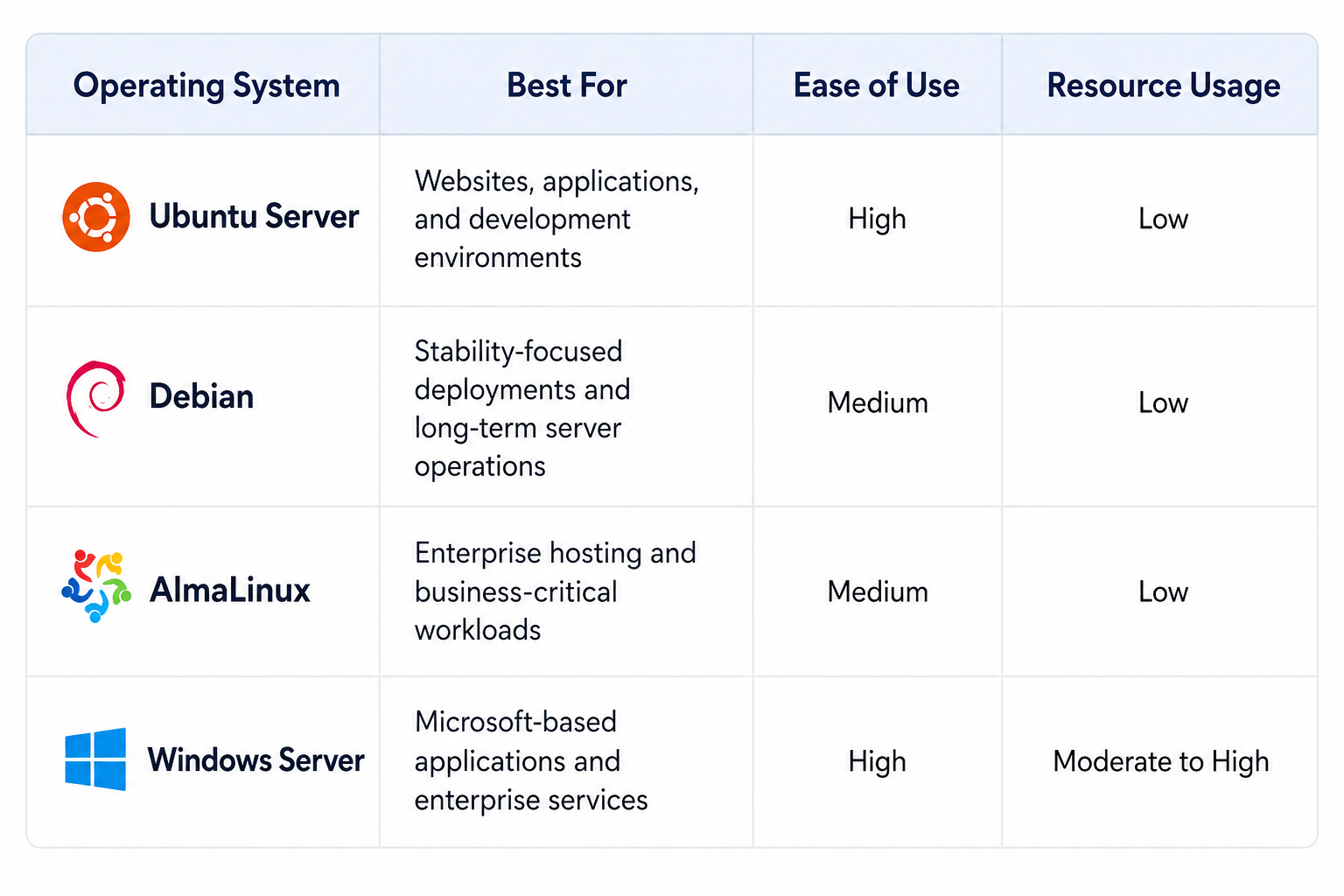
Match the Operating System to Your Administrative Experience
The feature-heavy operating system is not necessarily the optimal solution for all users.
Linux comes packed with many possibilities in terms of administration commands, and this makes it appealing both for software developers and IT professionals. Installing software, configuring servers, and solving any problems can sometimes be easily done using a command-line interface.
Windows Server comes with a graphical interface for system management, which might seem easier to handle for companies that lack Linux knowledge.
One should take into account who will be taking care of the maintenance of the server.
Evaluate Security and Long-Term Support
Operating systems should receive regular security updates and long-term support.
Businesses should implement the following:
- Two-factor authentication
- Timely security updates
- User permissions limitations
- Backup schedule
- Monitoring tools
These practices help maintain a secure hosting environment.
Choose an Operating System That Can Grow with Your Infrastructure
Server specifications are always dynamic. Increased traffic and application sizes result in increased demands.
Linux operating systems tend to be popular in scalable servers since they fit well with containerization, cloud computing, and automated technologies. These make it easy to scale up when an organization intends to do so.
When growth is rapid, most organizations tend to migrate from VPS servers to dedicated server India solutions due to increased demands on CPU resources. Planning ahead would help ease the migration process.
Verify Control Panel Support Before Deployment
Many administrators depend on control panels to make their tasks easier with regards to server administration.
Commonly used control panels include:
- cPanel
- Plesk
- DirectAdmin
- Webmin
Not all control panels work with all types of operating systems; for instance, cPanel works mainly on Linux, whereas Plesk operates on Linux and Windows.
Checking compatibility helps save time in moving and configuring the server software.
Understanding the Long-Term Cost of Ownership
The pricing of a VPS goes beyond just the monthly service charge.
The operating system license, management needs, compatibility issues, and administrative needs can all influence overall costs.
The use of the Linux OS is less costly since the software is open-source and does not require any licensing charges. The use of Windows Server software requires a separate license and is thus more expensive.
When the demands of the infrastructure become greater, some companies prefer to buy dedicated server hosting in order to have full access to their resources.
When a Dedicated Server Becomes the Best Option
While VPS hosting might serve well in many cases, there might come a time when even the most powerful VPS will not be able to cope with resource-consuming applications.
Dedicated Server India hosting might be the right choice for:
- Highly visited websites
- Big databases
- Corporate applications
- Resource-consuming applications
- Companies that need full hardware isolation
Most companies use VPS hosting in the beginning and then proceed to buy dedicated server hosting due to increasing traffic and application needs.
Using the services of the best dedicated server hosting providers could make the transition easier without interrupting the services.
What to Look for in a VPS or Dedicated Hosting Provider
When choosing a hosting provider, consider:
- Reliability of the infrastructure
- Availability of technical assistance
- Options for management services
- Operating systems available
- Possibility of security control
The best dedicated server hosting providers often offer both VPS and dedicated hosting, making future upgrades easier.
Final Thoughts
No single VPS operating system suits every application. For sites and applications, it is recommended that Linux be used, but Windows Server will be more appropriate for applications that are developed on the MS platform.
With increasing demands from the infrastructure side, an organization can opt for a dedicated server India option. Working with the best dedicated server hosting providers could prove beneficial for organizations.