Why Hybrid Email Hosting is the Future of Enterprise Communication


Enterprise communication is changing more rapidly than ever. Remote teams and the emerging cybersecurity risks, coupled with the escalating cost of software, are making businesses reassess their approach to email infrastructure. Conventional general mail email applications are becoming costly and rigid. This has seen most organizations switch towards Hybrid Email Hosting as a more intelligent and scalable solution.
But what is the reason behind the growth of Hybrid Email? And how would it ever address actual business issues as opposed to another layer of IT?
We should simplify it in some practical terms.
What is Hybrid Email Hosting?
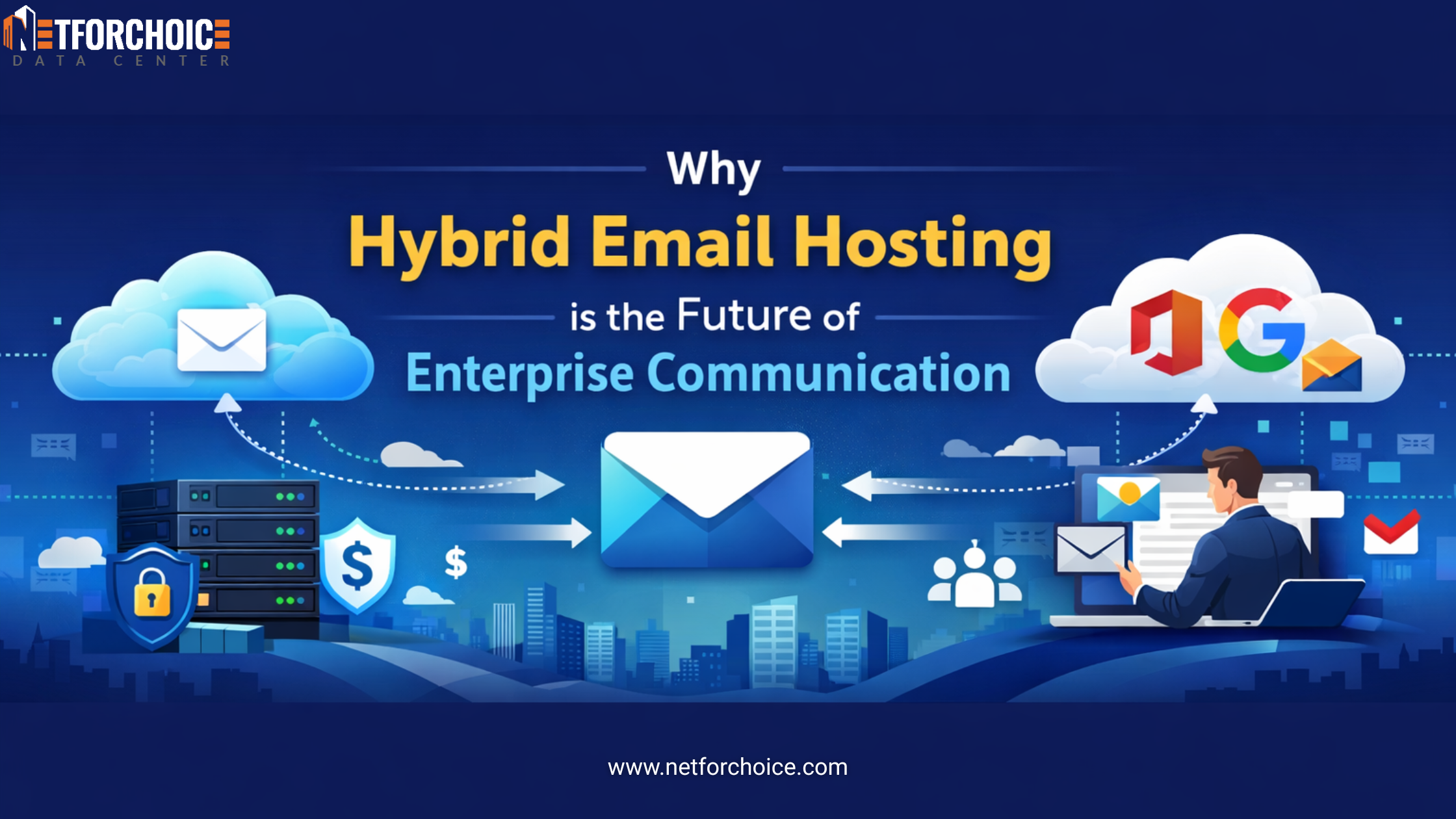
It is an integration of a cloud email service provider and a traditional hosted or locally managed mail service. In effect, it allows companies to run their mission-crucial email servers (such as executives or security-conscious departments) on the high-end cloud infrastructures (such as Google Workspace or Microsoft 365) and serve larger groups of users on an inexpensive hosted platform, all under the identical domain and administration.
The Traditional Email Hosting Core Business Challenges
- High Total Cost of Ownership: No matter what email system you are using, be it a completely on-premises deployment or a completely cloud solution, costs can grow exponentially, particularly with the high costs of premium cloud licensing charges and hardware charges.
- Security & Compliance Risks: Separate systems will not have a regular, enterprise-level security infrastructure and enforcement of regulations across all channels of communication.
- Limited Control with Full Cloud: Although public cloud services are convenient, there are still numerous organizations that require control of sensitive information at a more detailed level.
- Rigid Structure: On-premises product solutions are not scaled easily, and cloud-native products could be too expensive when a wide user base is needed.
Why Hybrid Email Hosting Is the Future
- Balanced Cost Efficiency
Unlike completely cloud-based email hosting services where one pays per user or feature level, hybrid models allow the enterprise to customize its investment. Companies can prepare important teams with advanced cloud services and retain most of the users in a less expensive email hosting platform. This saves much money in total without compromising on performance.
- Single-point Management, integrated Domain
In hybrid configurations, all email accounts are controlled by an IT team via one control panel. Centralized administration is easy to administer and offers less IT overhead, regardless of adding users, creating aliases, implementing policies, or incorporating sophisticated security filters. This is necessary for businesses with complex organization.
- Security & Compliance at Scale
Hybrid models will allow the organization to have the best of both worlds: cloud email security features (like encrypted transmission and multi-factor authentication) and control over sensitive information in dedicated hosting setups. This will help to reduce the effort to comply with regulatory standards, such as GDPR, HIPAA, or local data storage standards.
- Scalability & Future-Proofing
Hybrid systems can expand easily as the enterprises grow and the communication requirements change. The transfer or addition of users into and out of the cloud and hosted environment does not entail any downtime or a minimum of disruption. This flexibility makes communication infrastructure future-proof, without the need to re-architect the infrastructure in an expensive manner.
- Quality Performance and Availability
Enterprise email needs high availability and high reliability. Top hybrid hosting providers (like the NFC Mail-G Suite hybrid hosting that is offered to businesses) ensure uptime of up to 99.995% by using redundant infrastructures, so critical communications are never lost.
- Enterprise Support and Local Presence
In the case of companies with international operations, such as the email hosting in India, the presence of local support and data center is another level of reliability and performance. Localized cloud and hybrid email providers contribute to the decrease of latency and offer culturally sensitive care.
Selecting the appropriate Hybrid Email Hosting Provider
- Smooth Integration: An option to support the leading cloud platforms (e.g., Google Workspace or Microsoft 365).
- Central Control Panel: To ease the management.
- Strong Security: Multiple-level protection and high-level encryption.
- 24/7 Technical Support: This is essential when being an enterprise.
- Flexible Pricing: User- and resource-based scaling.
Conclusion
Business communication is changing in that there is a need to have systems that are secure, scalable, cost-effective, and simple to manage. Hybrid Email Hosting will fulfill all of these requirements and beyond, providing the connection between the old systems and the new cloud system. This is not only a choice for the enterprises that want to modernize but also stay in control and lessen the cost pressures as well; hybrid email is also the future of communication in the enterprise.