



We live in a world hungry for processing power. From streaming 4K video to training AI models that can write code and generate images, the demand on computing infrastructure has never been greater. At the center of this shift is a fundamental question: What is the difference between a GPU and CPU? And more importantly, why are enterprises racing to deploy a GPU server for their most demanding workloads? Let’s break it down clearly, without the buzzword fog.
What Is a CPU?
A Central Processing Unit (CPU) is the traditional brain of any computer. It’s built around a small number of powerful cores, typically 4 to 64, each optimized to execute complex tasks sequentially, one after another, at very high speed.
CPUs excel at everyday computing: running your operating system, handling web browsers, managing file systems, and processing business logic. They’re designed for low-latency, general-purpose tasks that require strong single-thread performance. Think of a CPU as a handful of brilliant specialists exceptional at handling complex, varied problems one at a time but not built to juggle thousands of simple calculations simultaneously.
What Is a GPU?
A Graphics Processing Unit (GPU) was originally designed to render pixels on a screen, a task that requires computing millions of values simultaneously. That need for parallel processing is exactly what makes GPUs so powerful beyond graphics. See also: What is a GPU? A Beginner’s Guide to Graphics Processing Units.
Modern GPUs pack thousands of smaller cores that can handle many operations at once. This makes them exceptionally well-suited for AI workloads, deep learning, scientific simulations, video rendering, and large-scale data processing. Where a CPU solves problems serially, a GPU attacks them in parallel, like replacing a handful of specialists with an army of fast, coordinated workers all solving pieces of the same puzzle at the same time.
GPU vs CPU: Side-by-Side Differences
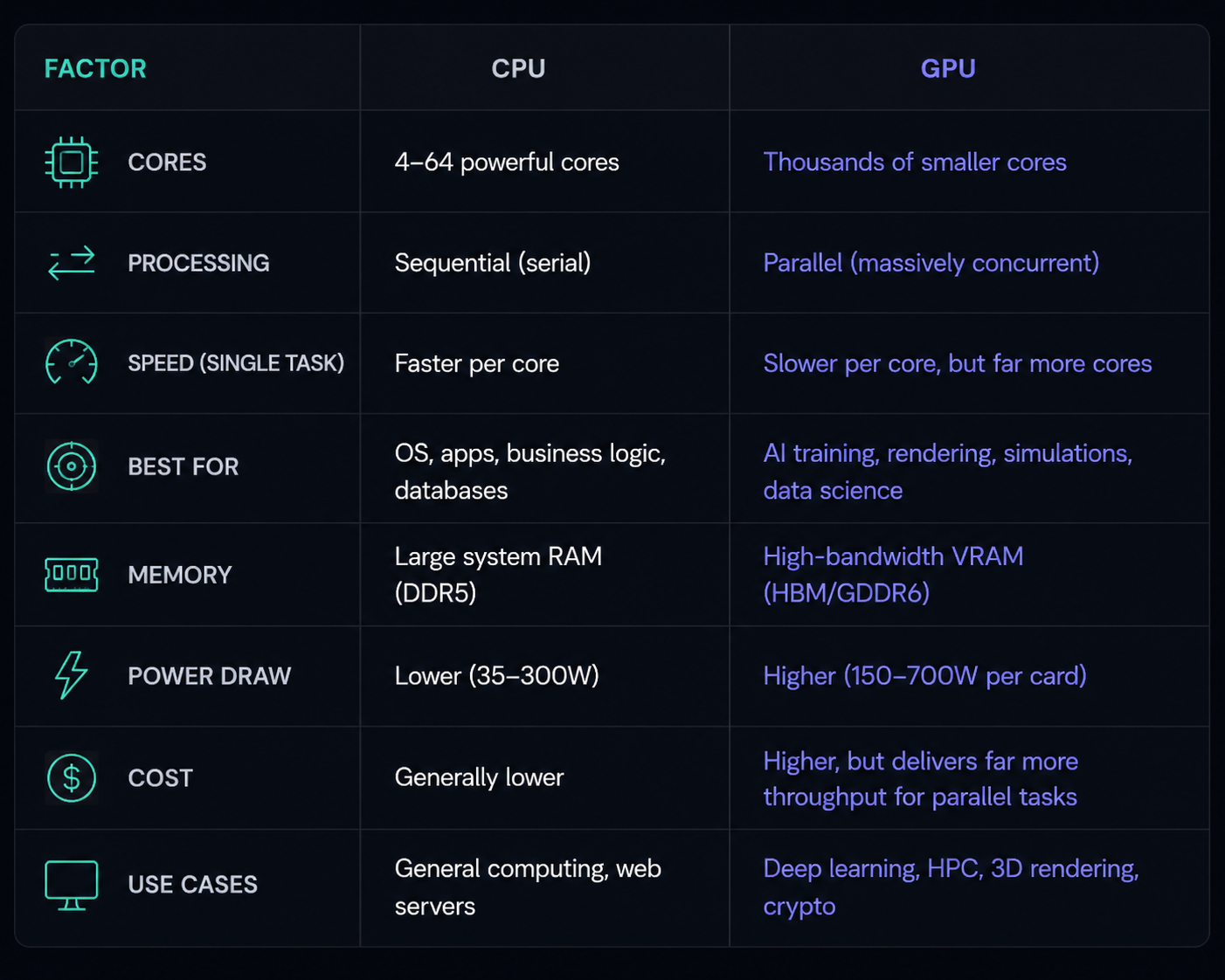
What Is a GPU Server and Why Does It Matter?
A GPU server is a high-performance machine or cluster of machines purpose-built to house multiple GPUs working in concert. Unlike a standard workstation with a single graphics card, a dedicated GPU server can host 4, 8, or even 16 GPUs interconnected with high-bandwidth links like NVLink, enabling them to share memory and work on massive problems together.
In a modern data center, these servers are the workhorses behind some of the most demanding tasks in technology today:
AI model training — Large language models and image generators require billions of mathematical operations. A GPU server can compress weeks of CPU training into hours. Deep learning inference at scale, scientific computing (drug discovery, climate modelling), 3D rendering and visual effects, and high-performance computing (HPC) for simulations all depend on GPU-accelerated infrastructure to stay competitive. See also: GPU as a Service (GPUaaS): A Beginner’s Guide to High-Performance Cloud Computing.
Who Should Use a GPU Server?
Not every workload demands GPU acceleration, but for these use cases, a dedicated GPU server isn’t optional, it’s essential:
- AI & ML Developers
- Data Scientists
- Deep Learning Researchers
- Game & VFX Studios
- Genomics & Drug Discovery Labs
- Financial Quant Teams
- Climate & Physics Researchers
- Autonomous Vehicle Engineers
Final Thought
CPUs remain essential for general computing, but the future of AI workloads, high-performance computing, and large-scale data processing belongs to parallel processing architectures. A GPU server isn’t just a hardware upgrade, it’s a strategic investment in what your infrastructure can actually achieve. Whether you’re training your first model or scaling a production AI pipeline, the right GPU infrastructure makes all the difference.
Explore GPU Server Options →