What Describes the Relationship Between Edge and Cloud Computing?


Stop Treating This Like a Battle
Every time a new technology comes along, the internet loves to frame it as a war. Edge vs cloud computing has fallen into the same trap, and it’s holding back a lot of businesses and developers from making smart architecture decisions.
Here’s the truth: edge vs cloud computing is not a choice between two enemies. It’s a story about two systems that were designed to work together. Cloud computing runs on a data center in cloud computing infrastructure that is powerful, centralized, and built for scale. Edge computing, on the other hand, brings processing closer to where you actually are. Once you see how the two complement each other, the whole picture changes.
A Quick Refresher
Cloud computing means running your applications, storage, and processing on remote servers typically in massive data centres operated by providers like AWS, Google Cloud, or Azure. When you stream a movie, back up your phone, or use an online spreadsheet, you’re using the cloud. It’s powerful, scalable, and centralized.
Edge computing moves processing closer to where data is actually created your phone, a factory sensor, a smart camera, or a connected car. Instead of sending raw data on a long round trip to a distant data centre, edge devices handle computation locally and instantly. Think of edge computing as the cloud’s quick-thinking field agent.
The Relationship Explained
Part A: Complementary Roles
When people debate edge vs cloud computing, they usually focus on speed and location. But the more useful lens is role. The cloud excels at heavy lifting: storing vast datasets, training AI models, running complex analytics, and managing global infrastructure. Edge computing excels at real-time reaction: detecting a machine fault before it causes an explosion, filtering video before it clogs a network, and responding to your voice command without a half-second delay.
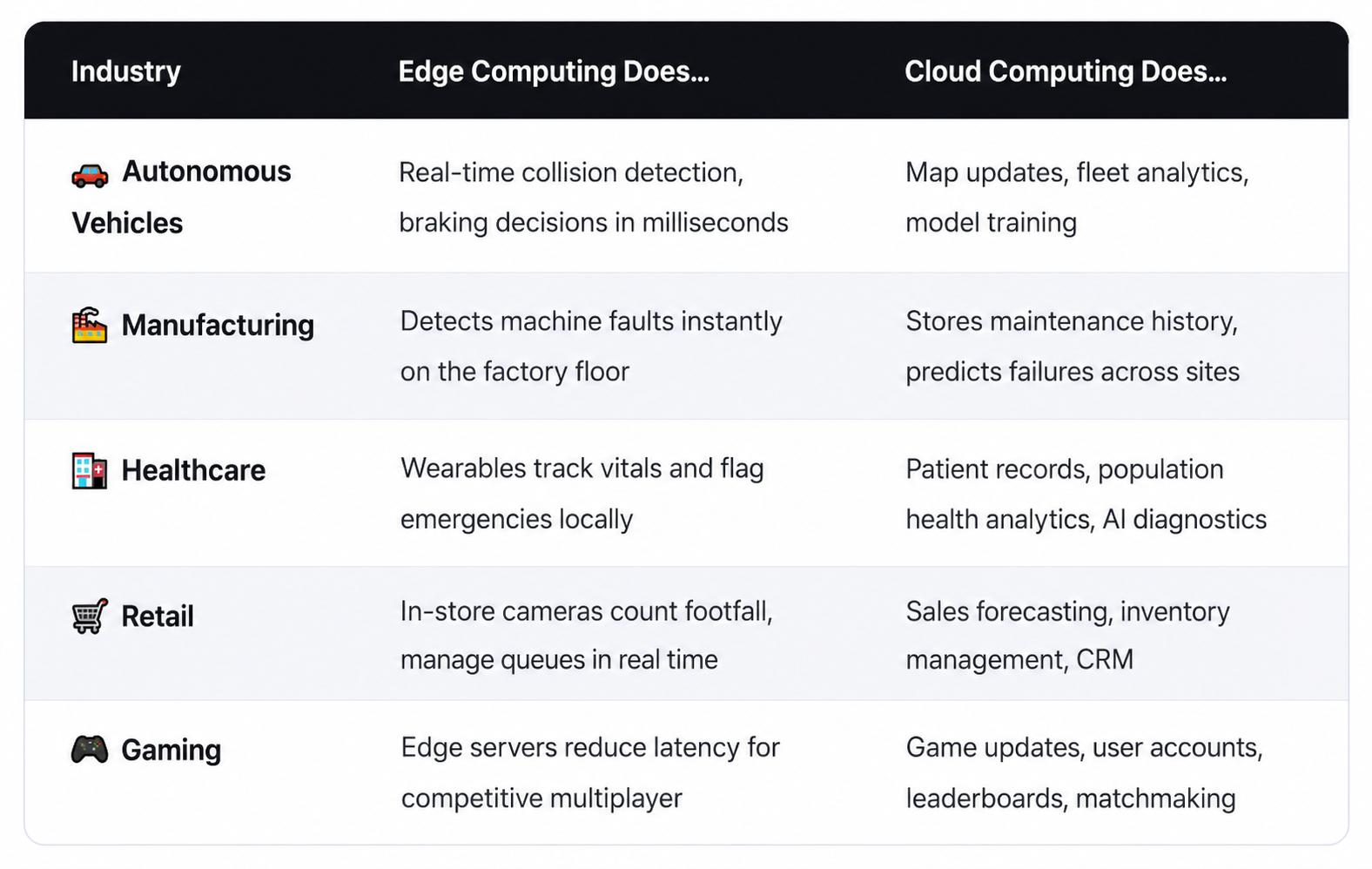
Neither can fully replace the other. A self-driving car needs edge computing to brake in milliseconds, but it needs the cloud to receive map updates and safety patches. They are roles in the same system, not substitutes for each other.
Part B: Data Flows from Edge → Cloud
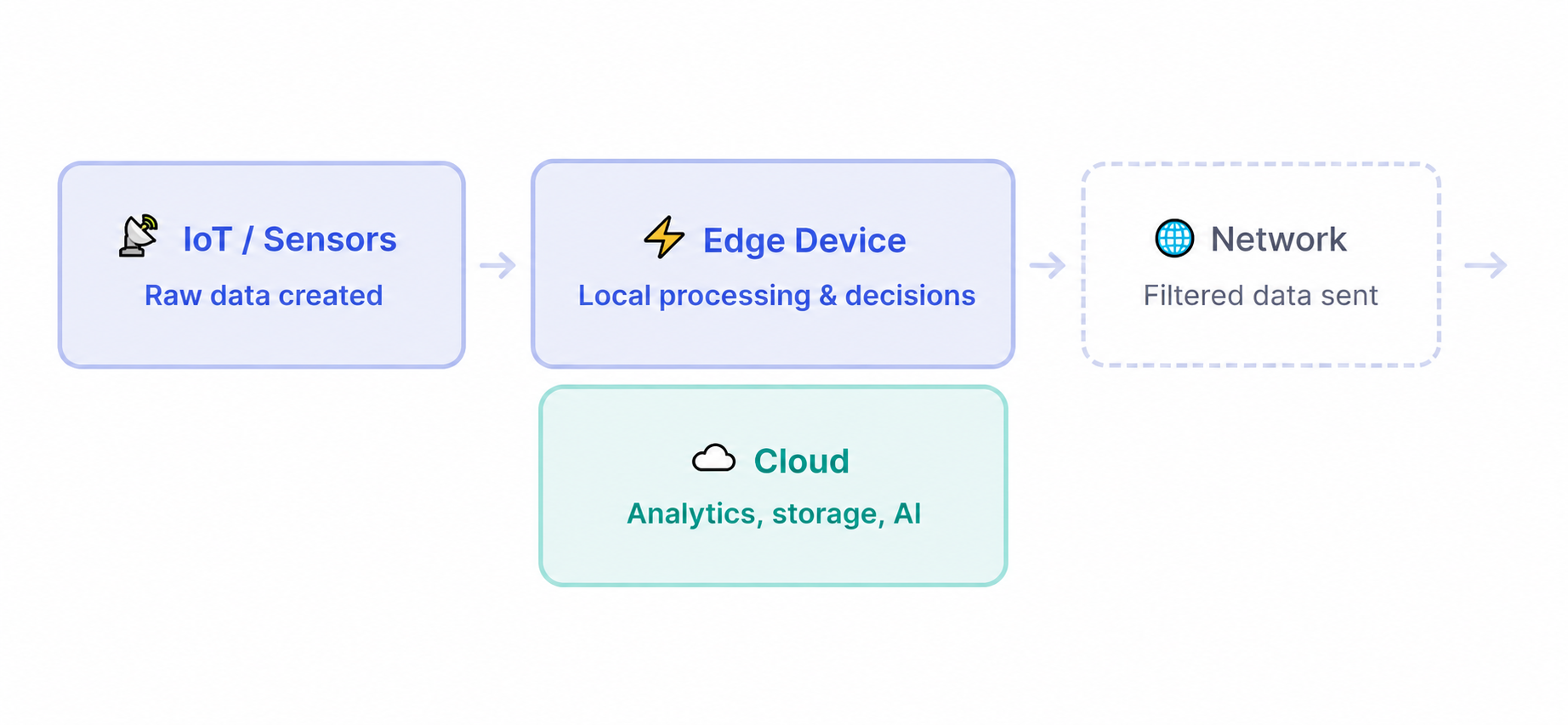
In most modern systems, data begins its life at the edge. A wearable records your heart rate. A factory sensor captures temperature readings every second. A retail camera counts foot traffic. Locally, these edge devices make immediate decisions, flag an anomaly, trigger an alert, or adjust a setting.
The filtered, summarized, or flagged data then travels up to the cloud for deeper analysis, long-term storage, and pattern recognition across thousands of devices. The edge acts as a smart pre-processor; the cloud acts as the strategic brain.
Part C: Cloud Enables the Edge
This is the part most people miss in the edge vs cloud computing conversation. The cloud doesn’t just receive from the edge it actively powers the edge. AI models trained in the cloud are deployed to edge devices. Software updates roll out via cloud orchestration. Configuration, monitoring, and security policies flow from centralized cloud management down to thousands of distributed edge nodes. Without the cloud, edge computing would be a collection of isolated, unmanageable islands.
Real-World Examples
Let’s make this concrete. Here are industries where edge vs cloud computing plays out every single day and how the two technologies divide the work.
Why This Relationship Is Accelerating
The edge vs cloud computing partnership is becoming more important, not less, thanks to three big forces reshaping technology right now.
-
5G Networks
Ultra-low latency and massive bandwidth mean more data can flow between edge and cloud faster than ever. 5G is the highway that makes the partnership viable at scale.
-
AI at the Edge
AI models are getting smaller and more efficient. Cloud-trained models now run locally on smartphones, cameras, and sensors bringing intelligence where the data lives.
-
IoT Explosion
Billions of connected devices generate data that cannot all be shipped to the cloud. Edge computing absorbs the flood; the cloud handles the strategy.
These three forces don’t just justify the edge-cloud relationship they demand it. Organizations that understand how edge and cloud computing divide responsibilities will be better equipped to handle the next decade of technological change.
What This Means for You
If you’re a business owner, the takeaway is practical: don’t choose between edge and cloud design with both in mind. Where do you need instant responses (customer interactions, safety systems, real-time inventory)? That’s edge territory. Where do you need deep analysis, storage, or cross-site intelligence? That’s where cloud computing earns its place. Building this hybrid intentionally will cut costs, reduce latency, and make your systems more resilient to outages.
If you’re a developer, the edge vs cloud computing distinction is becoming a core architectural decision, not an afterthought. Frameworks like AWS Greengrass, Azure IoT Edge, and Google Distributed Cloud are designed precisely to help you deploy logic across this continuum. Understanding where each layer sits helps you write faster, leaner, smarter applications.
If you’re simply a user, you’ve already lived this relationship. When you unlock your phone with your face (edge) and your photos back up automatically to Google Photos (cloud), you’re experiencing edge and cloud computing working together seamlessly without ever having to think about it. The goal of good technology design is exactly that: the seams disappear.